Sunday, February 11, 2018

Sermon: The Gerasene Demoniac

Favorite Bible Stories: “The Gerasene Demoniac”
Mark 5: 1-20
by Rev. Carson Overstreet
Van Wyck Presbyterian Church
January 28, 2018

We conclude our sermon series today with one of my favorite Bible stories and one of the most thought provoking of Jesus’ ministry.

As the Gospel of Mark tells the story, Jesus and his disciples get in a boat and sail across the Sea of Galilee. Within just a few miles of water they leave the Jewish world and cross over to the Greco-Roman world. The boat landed on the shore of Gergesa (or the town of the Gerasenes); one of ten cities of the Decapolis.

Bible teacher Ray Van der Laan shares the Decapolis had a Greek Helenistic worldview. The first century Greco-Roman world was very human-centered. What mattered most in life were one’s accomplishments, social status, accumulation of material wealth, and appearances. As a result, anyone who did not measure up to these values was held in no account and pushed to the very out-skirts of town, marginalized by society.[1]

Back across the sea of Galilee in Capernaum, the Jewish worldview was that one’s value was found in belonging to God. Value is tethered to God’s covenant love through Abraham. However Jewish tradition was particular about this covenant status of belonging. What mattered most was one’s ability to be and remain spiritually clean according to the Law of Moses. To be “unclean” or to associate with one who was “unclean” meant that one’s spiritual wholeness or purity was compromised. Marginalization was the result there too.

As Jesus and his disciples set sail for the town of the Gerasenes, the pot gets stirred among these two very different worldviews.

Keep this in mind as we hear Mark’s story in chapter 5 verses 1-20…..

They came to the other side of the lake, to the country of the Gerasenes. And when [Jesus] had stepped out of the boat, immediately a man out of the tombs with an unclean spirit met him.

He lived among the tombs; and no one could restrain him any more, even with a chain; for he had often been restrained with shackles and chains, but the chains he wrenched apart, and the shackles he broke in pieces; and no one had the strength to subdue him. Night and day among the tombs and on the mountains he was always howling and bruising himself with stones.

When he saw Jesus from a distance, he ran and bowed down before him; and he shouted at the top of his voice, ‘What have you to do with me, Jesus, Son of the Most High God? I adjure you by God, do not torment me.’ For he had said to him, ‘Come out of the man, you unclean spirit!’

Then Jesus asked him, ‘What is your name?’ He replied, ‘My name is Legion; for we are many.’ He begged him earnestly not to send them out of the country.

Now there on the hillside a great herd of swine was feeding; and the unclean spirits begged him, ‘Send us into the swine; let us enter them.’ So he gave them permission. And the unclean spirits came out and entered the swine; and the herd, numbering about two thousand, rushed down the steep bank into the lake, and were drowned in the lake.

The swineherds ran off and told it in the city and in the country. Then people came to see what it was that had happened. They came to Jesus and saw the demoniac sitting there, clothed and in his right mind, the very man who had had the legion; and they were afraid.

Those who had seen what had happened to the demoniac and to the swine reported it. Then they began to beg Jesus to leave their neighborhood.

As [Jesus] was getting into the boat, the man who had been possessed by demons begged him that he might be with him. But Jesus refused, and said to him, ‘Go home to your friends, and tell them how much the Lord has done for you, and what mercy he has shown you.’ And he went away and began to proclaim in the Decapolis how much Jesus had done for him; and everyone was amazed.


He was known as the Gerasene Demoniac. The demons he wrestled had stolen his ability to accomplish anything in life. Whatever the chaos was that tore through him, it erased his former identity, it denied him the opportunity to be understood, it cut off his relationships with family and community, and it stripped away his integrity. The Greco-Roman world taught him shame; no one would ever love him for who he was. This worldview broke him down to dust and left him belonging to nothing more than hopeless despair.

It is no surprise that this ghost of a man ran to Jesus when the Rabbi got out of the boat. Even in Gentile territory, this man knew exactly who Jesus was. And as Jesus began to drive out the man’s chaos with authority to heal, the man begged Jesus not to torment him. He had experienced all the torment and division he could handle.

Our Savior saw a man who was more than the hopeless story that defined him. Our Savior saw a man who was in desperate need of God’s healing the jagged edges of his soul. What Jesus does is nothing less than amazing grace: he restored this man’s humanity. Jesus clothed this man in God-given dignity.

Jesus asked this man what his name is. Can you imagine not hearing your name called for a great length of time? That simple question created a space of fostering a relationship. It also opened a window of opportunity for the man to tell his story. Jesus’ empathy and compassion claimed this man in God’s never-ending love and restored this man’s identity as a beloved child of God.

Jesus freed him of the chaos, pain and isolation that once defined his life. This man’s new life was now filled with purpose for he was sent to go back home and tell his story. Jesus reconciled this man from the inside out and re-familied him to the ones who had known this man as a son, a brother, and a friend.

And yet this man, now healed and made whole, still felt the weight of human judgment. He feared no one would see him as Jesus saw him. It is in this moment that Jesus reinterprets two colliding worldviews.

Jesus’ actions confronted the Greco-Roman worldview. Jesus’ compassion and healing proclaimed God’s truth that everyone is a child of God, worthy of love and belonging. The source of this core truth is that we are all created in God’s image. The Gerasenes were so offended and threatened that they told Jesus to leave the neighborhood.

Jesus’ actions reinterpreted the Jewish worldview too. Jesus revealed God is willing to bend the rules of tradition for the sake of reconciling all humanity and creation back to himself. God shows no partiality (Acts 10:34).

The disciples were amazed and more than likely shocked. They sat in that boat as this all played out. I can imagine their jaws dropped as their Rabbi did God’s work in forbidden places according to tradition.

The disciples would continue to learn that following Jesus is risky business. You have to get out of your comfort zone to be about the Lord’s work of breaking down barriers to God’s freedom. At the end of the day, the only thing that counts is faith working through love (Galatians 5:6).

Mark’s story haunts me with the stark contrasts in the ways humanity is viewed by God and society. The Gospel says that no one too far beyond God’s grace.

I want for you to think about the children, individuals, and groups whom society says have no value today. Anne Lamott says, “You can safely assume you've created God in your own image when it turns out that God hates all the same people you do.”

Now try to see the ones whom society holds of no account through the eyes of Jesus Christ. Jesus not only draws near to those whom society casts out, but he lived and died in compete solidarity with the marginalized and all humanity.

Jesus too was judged by society as having no value. The Greco-Roman society and the Pharisaic tradition saw his only accomplishment as stirring up trouble. Jesus was stripped of his God-given dignity and was held of no account. He hung on the cross to be publicly humiliated and to die as a criminal. And yet it was in the tomb that God lifted up a beacon of hope that shined the light of new life in the darkness. That light still shines into the darkest parts of humanity; a darkness that will never overcome the light of Jesus Christ.

God does his best work among the most disparaging places of life. The fullness of Jesus Christ and the power of Holy Spirit reveal God does this for the sake of reconnecting us - re-familying us - back to God and to one another. We do not belong to ourselves but to God alone and we are our brother’s keeper.

We still live in that first century mindset where a person’s worth and belonging are defined according to human standards - accomplishments, social status, possessions, and appearance.

In a time of great division, it is imperative for the greater Church to reclaim Jesus’ examples of empathy and compassion. These virtues are central to the integrity of the Gospel of Jesus Christ.

Empathy and compassion always begin with our perceptions. It starts as an inside job and first begins with the self. Our capacity to learn empathy starts within our first year of life as an infant. This potential is shaped by our home values, community of faith, and environment.

The first step is a humbling one. It is learning to articulate our feelings. As we grow older it is remembering the human heart is a roller coaster of emotions and emotional needs. In our moments of feeling lost and misunderstood, we are found by Jesus Christ. We all share a longing to be unconditionally loved and freed from our inner and external chaos. What an incredible moment to feel safely embraced and understood by the heart of our Creator! You and I are here today because we identify with the mystery of God’s grace.

The second step is no less humbling. It is to see through God’s truth that our marginalized sisters and brothers are the same kind of different as you and me. When we affirm our shared universal longing to be loved, it yields a deepening conviction that all have intrinsic value because all are made in the image of God. We do not earn our worth, rather it is God given.

This gives us courage to be empathetic towards others – to get out of the boat and commit to the Lord’s work of restoring God-given dignity to our sisters and brothers. The Spirit nudges us to draw near to those who are different and those who are on the margins and to be a beacon of light.

Empathy is a grace-filled space of human connection. Empathy requires us to seek to understand first so that we may come alongside another with compassion (willingness to suffer with another). These virtues are the ties that bind us together in Christian love. The only thing that counts is faith working in love.

What might the gospel look like in your life and mine if we strive to see through Jesus’ lenses of empathy and compassion? This question matters because if we call ourselves disciples of Jesus Christ then we are to be agents of God’s compassion. The Spirit is on the move to continue teaching us what we have learned and seen and heard in our Rabbi and Savior.

May we work for justice that heals and seek peace that reconnects us to God and one another in our homes, schools, community, nation, and world.

In the name of God the Father, Son, and Holy Spirit. Amen.

Sources Referenced:

[1] Ray Vaner Laan “The Mission of Jesus: 5 Lessons on Triumph of God’s Kingdom in a World of Chaos” (Grand Rapids: Zondervan, 2016), lesson 2 DVD, “Decapolis: The Other Side – Jesus and the Man from the Tombs”.

Sunday, February 4, 2018

Sermon: You Give Them Something to Eat!

Favorite Bible Stories: “You Give Them Something to Eat”
Luke 1:37; 9: 10-17
by Rev. Carson Overstreet
Van Wyck Presbyterian Church
February 4, 2018

The story of Jesus feeding the five thousand people is a favorite story among this congregation.

As Tony shared in his children’s sermon, Jesus gave his followers strength that they were learning how to live into.

This truth is important for Luke’s Gospel. He begins chapter nine stating that Jesus gave the twelve disciples power and authority and Jesus sent them to use this God-given strength to proclaim the kingdom of God and to heal (Luke 9:1-2).

Keeping that in mind, hear the rest of Luke’s story (Luke 9: 10-17) with fresh spiritual eyes….

On their return the apostles told Jesus all they had done. He took them with him and withdrew privately to a city called Bethsaida.

When the crowds found out about it, they followed him; and he welcomed them, and spoke to them about the kingdom of God, and healed those who needed to be cured.

The day was drawing to a close, and the twelve came to him and said, ‘Send the crowd away, so that they may go into the surrounding villages and countryside, to lodge and get provisions; for we are here in a deserted place.’

But he said to them, ‘You give them something to eat.’

They said, ‘We have no more than five loaves and two fish—unless we are to go and buy food for all these people.’ For there were about five thousand men.

And he said to his disciples, ‘Make them sit down in groups of about fifty each.’ They did so and made them all sit down.

And taking the five loaves and the two fish, he looked up to heaven, and blessed and broke them, and gave them to the disciples to set before the crowd. And all ate and were filled. What was left over was gathered up, twelve baskets of broken pieces.


Luke says because the disciples have been sent with God’s power to join Christ’s ministry they are now considered apostles – the sent ones. The marching orders which Jesus gave the apostles are based on Jesus’ servant leadership. Jesus did not ask them to do anything that he was not already doing. According to Luke, Jesus was sent by God for the purpose of proclaiming the good news of the kingdom of God (Luke 4:43).

According to Luke, the kingdom of God creates life-giving reversals:

God’s kingdom lifts up the lowly and brings down the powerful (Luke 1:52; 18:14; 18:17; 21:3-4);

provides abundance in the midst of the world’s scarcity (Luke 1:53; 11:3; 12:28: 13:19);

reveals merciful love in the midst of fear (Luke 1:54; 6:27-28; 10: 25-37; 23:44-46);

creates the power of presence in the midst of distraction and loneliness (Luke 10:41-42; 13:21);

brings healing and wholeness in the face of illness and brokenness (Luke 4: 31-35; 4:39; 5:13; 5:24; 6:8,10; 6:18; 7: 9-10; 7:14; 9:42; 13:13; 14:4; 18:42; 24:1-12);

accomplishes justice that redeems systemic oppression (Luke 1:51; 2:34; 3:5; 6: 20-26; 14:13-14; 14: 21; 18:5-8; Acts 13:17);

proclaims the gift of salvation to deliver God’s people (Luke 3:6; 15:7; 15:10; 15:22-24; 22:19-20; 23:43; 24:26-27, 30-32; 24:45-49).

Jesus loved talking with others about the truths of God’s kingdom. The crowds were drawn to Jesus’s presence and the picture his words painted. They had an insatiable hunger and thirst for God’s abundant presence that redefined human existence. God’s kingdom always provides the MORE we are looking for.

And yet the ones who Jesus sent to reveal the hopes of kingdom living (the apostles) were the ones who told Jesus to send the crowd away. This large gathering was in a deserted place – a place of scarcity. And the “sent ones” told Jesus to send the crowd away to find their own provisions in the midst of physical lack. Doesn’t this sound ironic to you?

Maybe the twelve saw an impossible situation confronting them. Maybe they felt confident helping a few people at a time, but right now they worried and doubted their resources to live into their calling.

Days later Jesus would tell them, “Do not worry about your life, what you will eat, or about your body, what you will wear….Your Father knows what you need. Instead strive for his kingdom and these things will be given to you" (Luke 12: 22, 30-31).

But in this moment Jesus says, “You give them something to eat (Luke 9:13). And then Luke makes a point to state this is a teaching moment. Luke no longer calls the twelve “apostles” but now calls them “disciples,” – the ones who are to follow the Rabbi’s every move and learn to live into their strengths and calling.

How did Jesus show how to strive for the kingdom first? How did Jesus proclaim the kingdom to those 5,000 people and the disciples?

Jesus affirmed his complete dependence upon God and his trust in God’s provision. Jesus offered the resources which were given to him and prayed God would bless them to reveal God’s abundance. And Jesus gave the disciples the opportunity to extend visible signs of God’s invisible grace (Luke 9: 16).

God makes a way when there seems like no way. Nothing is impossible for God (Luke 1:37). As Tony shared in the children's sermon, God's favorite word is "impossible."

And yet just as Tony shared in his children’s sermon, our human tendency is to focus on what we are lacking. It is the narrative the world teaches. And it is discouraging to say the least. But remember the kingdom of God has great power to reverse the ditches of life.

Some family sized churches feel stuck in the ditch, discouraged when they compare their communal resources to larger churches. It is like comparing a 90 member church to a large church with thousands of members. The smaller church often feels like its resources are a few loaves and fish while the big church budget overflows with potential.

But let me tell you – never underestimate the ministry of a small church! My spirit is overwhelmed by your conviction of God’s provision and your reliance upon the Lord.

This church is open to listen for opportunities to follow Jesus’ command, “You give them something to eat!” “You give them something that reveals the kingdom of God!”

You are following Jesus and proclaiming the kingdom of God is near through our partnership with HOPE Food Pantry. Our food donations join forces in a communal effort to feed nearly 5,000 individual families annually who are in need here in Lancaster.

You are following Jesus and proclaiming the kingdom of God is near with our noisy offerings for Dimes for Hunger. In Lancaster alone, we are helping to feed our elderly homebound neighbors with Meals on Wheels, feed homeless guests at the New Hope Soup Kitchen, and glean local produce for those in need.

You are following Jesus and proclaiming the kingdom of God is near with Thanksgiving baskets overflowing with all the special holiday trimmings and Christmas gifts for families who would otherwise wake up to nothing. These local families in Van Wyck see God’s unconditional love and abundant presence and celebrate the gifts of grace with new hope.

You are following Jesus and proclaiming the kingdom of God is near through our ecumenical ministry of Back to School Bash. So many here washed the feet of children whose feet were bruised and blackened from wearing shoes too small. You told the children the story of Jesus washing the disciples’ feet, and many of those children finished telling the story. You put new socks and shoes on over 800 children’s feet and they walked away knowing you love them for who they are and that God loves them too.

As followers of Jesus Christ, God is always presenting you and me with teaching moments. We are called to follow Jesus’ example of fully relying on God (FROG) and trusting in God’s provision.

We are to offer up the resources and strengths God has given us – no matter how small they might seem – and watch God do something amazing with them and through them! In doing so Jesus says that you and I are now the “sent ones” to give others something that reveals the kingdom of God is breaking in right here and right now!

May God’s Spirit continue to move among us to open our spiritual and physical eyes to see new opportunities to follow Jesus and proclaim the kingdom of God and to heal through the ministry of reconciliation.

May we jump in with all that we are and all that we have to join in God’s mission of transforming the world.

In the name of God the Father, Son, and Holy Spirit. Amen.

Monday, January 29, 2018

Sermon: Friends Who Will Carry You to Jesus

Favorite Bible Stories: “Friends Who Will Carry You to Jesus”
Mark 2: 1-12
by Rev. Carson Overstreet
Van Wyck Presbyterian Church
January 28, 2018

The story of the four friends who carry the paralytic to Jesus is another favorite story among this congregation. Our own Laura Clark says this story is church at its best!

Hear the story with fresh spiritual eyes according to Mark’s Gospel 2: 1-12…


When [Jesus] returned to Capernaum after some days, it was reported that he was at home.

So many gathered around that there was no longer room for them, not even in front of the door; and he was speaking the word to them.

Then some people came, bringing to him a paralysed man, carried by four of them. And when they could not bring him to Jesus because of the crowd, they removed the roof above him; and after having dug through it, they let down the mat on which the paralytic lay.

When Jesus saw their faith, he said to the paralytic, ‘Son, your sins are forgiven.’

Now some of the scribes were sitting there, questioning in their hearts, ‘Why does this fellow speak in this way? It is blasphemy! Who can forgive sins but God alone?’ At once Jesus perceived in his spirit that they were discussing these questions among themselves; and he said to them, ‘Why do you raise such questions in your hearts? Which is easier, to say to the paralytic, “Your sins are forgiven”, or to say, “Stand up and take your mat and walk”? But so that you may know that the Son of Man has authority on earth to forgive sins’—he said to the paralytic— ‘I say to you, stand up, take your mat and go to your home.’

And he stood up, and immediately took the mat and went out before all of them; so that they were all amazed and glorified God, saying, ‘We have never seen anything like this!’


Mark, Matthew, and Luke all tell this story, but Mark is the one who best captures what is profound about this story (Matthew 9: 1-8; Luke 5: 17-26).

Jesus is at home surrounded by people who are packed in like sardines. Imagine an ordinary day where this sanctuary, the fellowship hall, and the Vaughan Room are so full it is standing room only. Imagine the cars passing by and drivers wonder what in the world is going on at THAT church?!?! Imagine the capacity is so full it violates fire code and the Fire Department has to come to ensure our safety!

Mark says the folks who gathered in that house were hanging on Jesus’ every word. He was teaching the Scriptures and I’m sure he was connecting all the dots to apply God’s Word to real life. Can you just imagine sitting at the feet of Jesus? Can you hear yourself thinking about that one friend or family member who is not by your side in that moment and you say to yourself, “Man, so-and-so should really be here too!”

The four friends were thinking the same thing. They knew someone who needed to be at the feet of Jesus. The text does not reveal to us anything about their relationships to one another.

We only know four things: The four friends go above and beyond to carry this unnamed man to Jesus; paralysis created an inability for the man to act for himself; Jesus saw the four friend’s confidence in Jesus’ healing power and power to change one’s life; and all were amazed by the extraordinary grace of the four saints and Jesus which brought healing and wholeness to the man.

It is a powerful thing when we see ourselves in these Bible stories. God’s faithfulness continues to be at work in mysterious ways, especially through the actions of friends and strangers alike. A few of our church folk among us gave me permission to share their own stories with you.

When Vivian was thirty years old and living in Tennessee, a friend dragged her to a Bible study. At the time Vivian’s daughters were preschool age and you know it takes a lot of effort to go anywhere with little ones! The Bible study was not just down the street, it was twenty miles away and Vivian was not so sure about making the commitment. Nevertheless, she participated in that women’s study which was led by Kay Arthur. Vivian remembers how inspiring Kay’s leadership and teachings were. While Vivian had been a life-long Christian, she was amazed to learn about Jesus’ power revealed in his death and resurrection and the ways it completely changes our lives. Vivian’s friend carried her to Jesus in a profound way that continues to shape her faith today.

Our Tuesday Morning Women’s Bible Study Group tears open the roof on a regular basis as we dig into God’s Word with engaging discussions and sharing differing insights. Our time together gives Glenda pause as she sees this group raising the roof in prayer for family, friends, neighbors, the community, and the wider world. Being lifted in prayer sounds like an undramatic way to carry a friend to Jesus, but prayer is powerful beyond measure. Glenda has some wise insight: it's our everyday Christian friends who carry us through prayer to Jesus' feet for comfort, healing, and guidance. She thanks God every day for surrounding her with people who believe in the power of prayer and having the faith that our prayers will be answered.

Another member shared their story of the church at its best during a difficult season of life and faith. In very dark days of my own life, I was not able to get to Jesus on my own. I was paralyzed with grief and depression, unable to get up and walk. I felt like God had abandoned me. It was only through the love and support of my friends that I was able to get to Jesus. The love and acceptance of my church friends carried me and lowered me through the roof back into God's presence. This experience changed my life. I learned that my prayers, church attendance, and service were not transactions to receive God’s grace, but nurture my relationships with God and the community of faith.

These collective stories from our community of faith are inspiring. They also point to what is so profound about Mark’s telling of this story. The profound truth is that when we see the good news of Jesus Christ in action it is a picture of bearing up one another in unconditional love (Ephesians 4:2).

When we bear up one another it is not according to our own agendas, or to get any special recognition, or to have God’s grace credited to our faith account. To bear up one another in God’s unconditional love – to carry friends, neighbors, and even strangers to Jesus - is a gift and a responsibility as a follower of Jesus Christ.

Paul’s letter to the church in Ephesus is solely focused on uniting the community of faith so it may be built together spiritually into a dwelling place for God (Ephesians 2:22). Paul says Jesus Christ is the foundation of God’s household (Ephesians 2:20).

It is through Jesus Christ that the whole structure of God’s people is joined together as a community. At times Holy Spirit gently softens the rough places of our hearts and yet at other time tears open the rough places in order for us to see Jesus as the only One who can satisfy our spiritual needs (Ephesians 2: 21-22).

God’s love works through our family, friends, neighbors, and even strangers to gather us into the spiritual house that Jesus is building. Carol Johns says, God never loved me in such a way till He brought you to me and said, “BEHOLD A FRIEND!" And that is part of the gift.

We are led by God’s love with the help of others, as Carol so beautifully said, to sit at Jesus’ feet and our lives begin to change. Holy Spirit transforms us by the renewing of our hearts, minds, and strength (Romans 12:2). As we find God’s peace and experience the wholeness that only Jesus Christ can provide, then we behold the gift of grace and also the responsibility to respond to it in kind.

Paul says we are to “Lead a life worthy of the calling to follow Jesus Christ with all humility and gentleness, with patience, bearing up one another in love, and making every effort to maintain the unity of the Spirit in the bond of peace (God’s wholeness). That unity means that God’s love empowers us to practice community in authentic ways so that we may be a blessing to one another, to the community, and to the wider world.

This week I want you to prayerfully consider the ways God’s Spirit might be nudging you.

Who is God bringing to your mind in prayer? Who is God placing in your path that needs to get to Jesus?

May you and I continue striving to be a community of faith who is united to being transformed by God’s love, Jesus’ grace, and the Spirit’s embrace.

May we be known as friends who will carry others to Jesus.

In the name of God the Father, Son, and Holy Spirit. Amen.

Monday, January 22, 2018

Sermon: Let the Little Children Come

Favorite Bible Stories: “Let the Little Children Come”
Matthew 19: 13-15
by Rev. Carson Overstreet
Van Wyck Presbyterian Church
January 21, 2018


I have been asking you to share your favorite Bible stories with me. One of the stories you lifted up is the story of Jesus welcoming the children from Matthew’s Gospel.

The camera lens of faith captures a tender moment that is not to be forgotten. Listen to the story according to Matthew with fresh spiritual eyes… Mathew 19: 13-15:

Then little children were being brought to him in order that he might lay his hands on them and pray. The disciples spoke sternly to those who brought them; but Jesus said, ‘Let the little children come to me, and do not stop them; for it is to such as these that the kingdom of heaven belongs.’ And he laid his hands on them and went on his way.

Matthew, Mark, and Luke all tell this story of a gentle Jesus. Throughout these gospels Jesus draws a crowd as the people continued to follow him. They gathered around Jesus like sheep without a shepherd (Mark 6:34). All three writers imply that mothers, fathers, and guardians were the ones bringing their children of all stages and ages to be blessed by the hands of the Son of God.

The people had heard Jesus’ powerful teachings and had seen unparalleled compassion in his eyes. Bringing their children was a beloved sign of trust in Jesus. These families wanted that holy connection to embrace and bless their children.

And just like that - this tender moment was interrupted. The disciples attempted to set a boundary around Jesus. Maybe they thought their Lord was doing important work. Maybe the disciples felt their Rabbi shouldn’t be bothered by the unpredictability of children – you know the tantrums, the questions, the interruptions. Maybe the disciples had good intentions to protect Jesus’s time and personal space, to preserve it, and keep it reverent.

And yet once again Jesus breaks down the barriers that we humans build up. “Let the little children come to me and do not hinder them for the kingdom of heaven belongs to such as these” (Matthew 19:14).

Those words speak the truth in love to the disciples and anyone with ears to hear. Those words call to mind an important truth about the ancient paths of faith tradition.

The Jewish faith tradition was and is a communal one. It claims that children have a treasured place of belonging in the family of faith. Children are marked with the sign of God’s covenant love (circumcision) from infancy at 8 days of age without exception (Genesis 17: 9-13).

A child’s life is to be interwoven in the fabric of covenant strength. The needle of faith weaves and tethers that fabric by intricate connections between God and intergenerational relationships. The fabric is made strong by a love that acknowledges the Lord as God alone with all our hearts, souls, and might.

Faith matters because it shapes the way we see ourselves and the world. Faith is cultivated in every day conversations that intersects real life in the home and also with our steps to walk in Wisdom’s path. It is a heritage that God’s steadfast love has passed down throughout every generation (Deuteronomy 6:4-9).

The Reformed faith tradition is rooted in the Old Testament tradition in Scripture. We mark infants and children with the sign of God’s covenant love in the Sacrament of Baptism. A child’s life is claimed as a beloved child of God, embraced in the grace of Jesus Christ, and tethered into the great family of faith by Holy Spirit. The Sacrament recognizes it takes a village to raise a child and root them in the wonders of God’s love.

And as this holy Sacrament embraces children, families, and community alike, Jesus’ words remind us that the kingdom of heaven belongs to such as these. Our children belong to the kingdom because you and I have something to learn about God’s love through the eyes of a child.

Just as the disciples were so easily caught up with adult matters, we can be too. There is a hazard with adulting too hard. It can extinguish one’s humility. It can hinder one’s ability to live in the moment. It can snuff out one’s playfulness, curiosity, and wonder. Jesus teaches us adults that children hold the keys to kingdom living.

Michael B. was one of the cutest four-year olds I had ever met. He had the face of a cherub, a smile that melted your heart, and an honesty that oftentimes left me speechless. One Wednesday afternoon his grandmother brought Michael B. and his siblings to church. I opened the door to help the kids get out of the car. And I said, “Michael B., did you have a good day at preschool?” And with a big mischievous grin, Michael B. looked at me and said, “Yeah! I didn’t hit anybody today!”

Let the little children come to me and do not hinder them, for the kingdom of heaven belongs to humble ones such as these.

The kids gathered around my clergy colleague for the children’s sermon. The message was to think about what God is calling us to do. All of the children had such good answers: “Be nice;” “Be kind;” “Be obedient.” And then little Henry buried his face in his father’s robe muffling his answer. The pastor looked down at his son and said, “Yes, Henry, God IS calling you to poop on the potty.” And little Henry just looked out at his church family and says, “But I not gonna do it.” The church broke out in hilarity.

Let the little children come to me and do not hinder them, for he kingdom of God belongs to those who live in the moment.

Two children were asked to help lead worship as acolytes to light the candles on the Communion Table and bring the light of Christ into God’s house. Those kiddos just so happened to be wearing an Native American headdress and a princess dress respectively. While some parents would see this as a stumbling block to church tradition, these children’s parents saw an opportunity to foster a child’s energy, imagination, and love. And this pastor is incredibly grateful for a church who values creativity.

Let the little children come to me and do not hinder them, for the kingdom of heaven belongs to those who are playful.

The youth gathered regularly for games, Bible study, and serving the community. As they grew in their faith, they also sought answers to hard questions. Paul began to withdraw from the group as he began to question who God is and what faith means. It was scary for his parents to see Paul holding this gift of faith and stretching it to the limits. Sometimes faith seems so fragile that we might believe questioning it is the wrong thing to do. But questions remind us that it takes a village to affirm that we are not alone in our questions and doubts. It is part of wearing the thin skin of humanity.

Let the little children come to me and do not hinder them, for the kingdom of God belongs to those who are curious and questioning.

Copper was a sophomore in high school. While he was shy he also did not know a stranger. He loved to laugh. He tried to do his best in school. He had a passion for soccer. He also had a spiritual gift for leadership. Cooper led devotions and prayer at youth retreats. He applied to serve on the Youth Council to help plan regional youth events. And the Church Officer Nominating Committee prayerfully invited Cooper to serve on session as a youth elder. I was delighted to hear his answer was yes. In that three year commitment many saw the Spirit at work through Cooper. He inspired the session and church to see children and youth not solely as the future but for the valuable contributions they share among us today.

Let the children and youth come to me and do not hinder them, for the kingdom of God belongs to ones who have a sense of wonder.

Today three families are bringing their children to be blessed by our gentle Jesus and this congregation. Mia Edwards, Carson Helms, and Ashley Overstreet are preparing to begin the journey of Confirmation this coming weekend. From January through May they will gather with other youth in our Presbytery to hold, question, and stretch this gift of faith.

Mia, Carson, and Ashley – I want you to know that you will step into a safe space that promises to hold future friendships among your peers. You are already fully embraced by the great family of faith right here at Van Wyck Presbyterian, the connective relationships among our Presbyterian churches, and all our spiritual ancestors who have come before us. And as you each grow deeper roots of faith, God has already given you amazing gifts to share among all God’s people.

My greatest prayer and deepest hope is that you may begin to unravel the mysteries of God’s amazing love for you, creation, and the wider world; to know that Jesus Christ welcomes you just as you are; and to trust that the Holy Spirit will give you the words to articulate your faith and help you discover how to use your unique gifts to make this world a better place.

The kingdom of God belongs to you and we cannot wait to see it through your eyes!

In the name of God the Father, Son, and Holy Spirit. Amen.

Sunday, January 14, 2018

Sermon: The Lord Will Fight for You

Favorite Bible Stories: “The Lord Will Fight for You”
Exodus 14: 1-25
by Rev. Carson Overstreet
Van Wyck Presbyterian Church
January 14, 2018

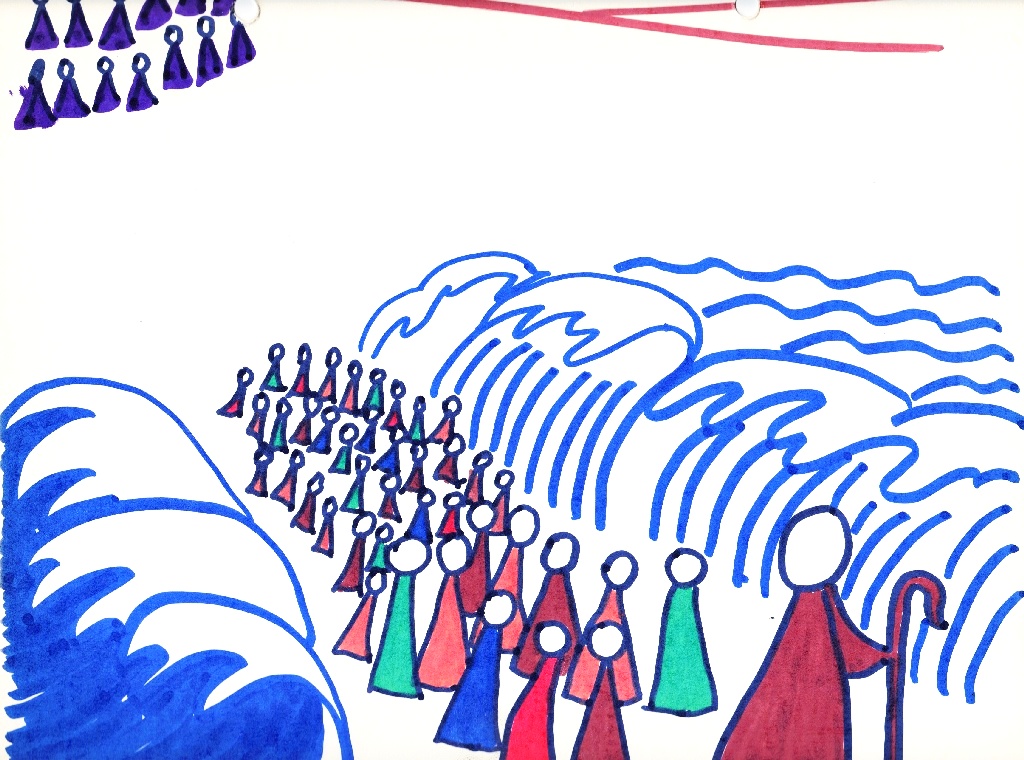
Then the Lord said to Moses: ‘Tell the Israelites to turn back and camp in front of Pi-hahiroth, between Migdol and the sea, in front of Baal-zephon; you shall camp opposite it, by the sea. Pharaoh will say of the Israelites, “They are wandering aimlessly in the land; the wilderness has closed in on them.” I will harden Pharaoh’s heart, and he will pursue them, so that I will gain glory for myself over Pharaoh and all his army; and the Egyptians shall know that I am the Lord.’ And they did so.

When the king of Egypt was told that the people had fled, the minds of Pharaoh and his officials were changed towards the people, and they said, ‘What have we done, letting Israel leave our service?’ So he had his chariot made ready, and took his army with him; he took six hundred picked chariots and all the other chariots of Egypt with officers over all of them. The Lord hardened the heart of Pharaoh king of Egypt and he pursued the Israelites, who were going out boldly. The Egyptians pursued them, all Pharaoh’s horses and chariots, his chariot drivers and his army; they overtook them camped by the sea, by Pi-hahiroth, in front of Baal-zephon.

As Pharaoh drew near, the Israelites looked back, and there were the Egyptians advancing on them. In great fear the Israelites cried out to the Lord. They said to Moses, ‘Was it because there were no graves in Egypt that you have taken us away to die in the wilderness? What have you done to us, bringing us out of Egypt? Is this not the very thing we told you in Egypt, “Let us alone and let us serve the Egyptians”? For it would have been better for us to serve the Egyptians than to die in the wilderness.’

But Moses said to the people, ‘Do not be afraid, stand firm, and see the deliverance that the Lord will accomplish for you today; for the Egyptians whom you see today you shall never see again. The Lord will fight for you, and you have only to keep still.’

Then the Lord said to Moses, ‘Why do you cry out to me? Tell the Israelites to go forward!

But you lift up your staff, and stretch out your hand over the sea and divide it, that the Israelites may go into the sea on dry ground. Then I will harden the hearts of the Egyptians so that they will go in after them; and so I will gain glory for myself over Pharaoh and all his army, his chariots, and his chariot drivers. And the Egyptians shall know that I am the Lord, when I have gained glory for myself over Pharaoh, his chariots, and his chariot drivers.’

The angel of God who was going before the Israelite army moved and went behind them; and the pillar of cloud moved from in front of them and took its place behind them. It came between the army of Egypt and the army of Israel. And so the cloud was there with the darkness, and it lit up the night; one did not come near the other all night.

Then Moses stretched out his hand over the sea. The Lord drove the sea back by a strong east wind all night, and turned the sea into dry land; and the waters were divided. The Israelites went into the sea on dry ground, the waters forming a wall for them on their right and on their left. The Egyptians pursued, and went into the sea after them, all of Pharaoh’s horses, chariots, and chariot drivers.

At the morning watch the Lord in the pillar of fire and cloud looked down upon the Egyptian army, and threw the Egyptian army into panic. He clogged their chariot wheels so that they turned with difficulty. The Egyptians said, ‘Let us flee from the Israelites, for the Lord is fighting for them against Egypt.’
- Exodus 14: 1-25


Over the course of our lifetimes, Scripture comes alive to each of us. God's Word often speaks to us in surprising ways to bring comfort in distressing times, to deepen the roots of our faith, and to prune those roots by challenging us.

No matter how young or old we are, when we learn about the B-I-B-L-E, we all come to hold a favorite biblical passage that becomes meaningful. For in the story God speaks directly into our hearts. Therefore, Scripture becomes quite personal to us as God rewrites our own personal and communal stories. And because of this deepening relationship with the Author of our lives, we are forever changed by God’s Word in some small or big way.

One of the most important stories in Scripture, and also one of my personal favorites, is the story of God parting the Red Sea. The familiarity of the story can cause our spiritual eyes to focus on the sheer wonder of God separating this massive body of water.

But there is more to the story that holds implications for our trust in God’s power and our faithful response to it.

Pharaoh and the Egyptians clung to Israel like baggage they could not rid themselves of. Whatever direction that God’s people looked they heard that seductive voice of fear, “The wilderness has closed in on you. This is as good as it gets. There is no way out.”

You and I know the power of that voice and how heavy that baggage gets. It made God’s people complacent to believe that nothing would ever change their circumstances. To imagine anything other than this baggage was too, too hard.

Complacency gets comfortable because it confines us to a particular lot in life. Complacency defines us in underwhelming ways. It ties our hands behind our backs. Complacency strives to hold us down in the darkness. It denies us the hope to spread our wings and rise up to the light.

But hope that is seen is not hope. For who hopes for what is seen? But if we hope for what we do not see, we wait for it with patience (Romans 8:24b-25).

I love this story because Moses sees all this in real time and he knows what time it is. It is time for Moses to tell his truth.

Moses was once in the same boat. His own complacency with self-doubt, fear, and feeling inadequate kept him from rising up to God’s call. And yet time and again Moses saw the surprise of God’s power and deliverance in his own life and in the lives of God’s people.

In a climactic moment of leadership, Moses says: Do not fall prey to fear and complacency. Stand firm in full reliance upon God. He is the stable center of your hope. Give all your attention to the hope that God saves. Your baggage is heavy and exhausting but prepare yourself - you will never carry it again. I know this is not logical but trust that the Lord will accomplish this today. The Lord will fight for you, and you have only to be still (Exodus 14:13-15).

Joan Chittister is an author and speaker on the spiritual life and was a former Benedictine nun. She says,

“There are some things in life that cannot be avoided: death, illness, change, personal expectations. What each of them does to us depends a great deal on the way we have allowed ourselves to deal with lesser things. The purpose of stability [Moses’ instruction to be still] is to center us in something greater than ourselves so that nothing lesser than ourselves can possibly sweep us away.

Stability says that where I am [that] is where God is for me. More than that, stability teaches that whatever the depth of difficulties around me, I can, if I will simply stay still enough of heart, find God there in the midst of them.”


God is acquainted with all our ways and hardships. God is faithful and gives us the assurance of his presence. The Lord goes before us and is our rear guard to shine the light into the darkness. If God is for us who can be against us? (Romans 8:31).

God will fight for us because the Lord our God is with us and he is mighty to save. He will take great delight in us, he will quiet us in his love, he will rejoice over us with a song of deliverance (Zephaniah 3:17).

God always makes a way forward when there seems like no way. Faith allows us to wait for God’s plan and God’s timing to intersect with great anticipation. We do not wait passively of helplessly. We wait with a prayerful eagerness that the Lord will never leave us where God found us.

And then we can be still no longer. God worked through Moses to part the Red Sea but notice that God did not carry the Israelites across the dry land. God said to Moses, “Why do you cry out to me? Tell the people to go forward!” (Exodus 14:15).

God prepared the path of deliverance, but the people had to respond in faith by taking the next step to experience God’s freedom. How can we possibly look forward into God’s future if our eyes are fixed on the past that lies behind us? Our attention is divided if we do that.

Years ago, Jake Clark met Pastor Lorenzo on a mission trip to Costa Rica. Pastor Lorenzo was a man you can not forget; he always had a big smile on his face and a joyful presence. One day, Jake just happened to share a story about prison ministry with Pastor Lorenzo. In those moments God led Pastor Lorenzo to tell his story of God’s faithfulness.

As a child Lorenzo never knew his father. Lorenzo’s young mother gave him away at birth. I imagine much of his life story was narrated by the voice of abandonment. Lorenzo was adopted and raised by a farming couple. He was not exposed to the blessings of faith community, but he was exposed to hard labor, violent beatings and verbal abuse. At the age of 15 he stole money from his parents and ran away. Daily survival on the street came from fighting for pay.

Lorenzo married and his wife bore children. The cycle continued as Lorenzo unleashed his anger on his wife and children. At the age of 25 Lorenzo was arrested for stealing and left to serve a prison sentence. He wandered aimlessly in a wilderness that was closing in on him. There seemed to be no hope to rise up from the darkness into the light. But hope that is seen is not hope, is it?

Prison was a stable center for Lorenzo; it forced him to be still. And in the stillness of a prison cell someone shared the good news of God’s deliverance with him. Lorenzo put his trust in God’s steadfast love, the grace of Jesus Christ, and the deep embrace of Holy Spirit and it changed his life.

When Lorenzo served his sentence and was released from prison, he had no idea what freedom might truly look like. Nor did he have any expectation that his wife and children would forgive him. The only thing Lorenzo knew was that he was a different man. But God made a way forward when there seemed like no way. God’s plan and timing intersected before Lorenzo and God’s Spirit nudged him to take the first step into God’s freedom.

In doing so, Lorenzo’s family forgave him. Surely God went ahead of them and was their rear guard because Lorenzo and his family were able to make peace with the past and reach forward into the promises of new life. The Lord used Lorenzo’s wilderness and baggage to glorify God; the Spirit called Lorenzo to serve God and God’s people as a pastor. God rewrote Lorenzo’s story of abandonment and pain with the finger of God’s grace.

Today Lorenzo’s story is knowing he is loved beyond measure and has a greater purpose in life within the heart of God. That story brings a smile and abiding joy for he is deeply aware of the power of God’s grace. And now Pastor Lorenzo helps others to see God’s deliverance as a new reality.

Friend, how long have you felt that you are wandering aimlessly in the wilderness? I know how heavy that baggage can become; the baggage of broken relationships, past regrets, deep doubts, and hard decisions in the mix of daunting uncertainty. I know how seductive the voice of complacency can be; it dulls our hearts to believe this is as good as it’s going to get.

Do not be afraid. Stand firm by fully relying on God. Give all your attention to the truth that God saves. Do not the let the past divide your attention.

God delivered us once through Jesus’ death and resurrection and God will deliver us again and again from anything that stands in the way of experiencing Christ’s promises of freedom and new life. Believe against all odds that the Lord will deliver you and then live into God’s reality.

The Lord will fight for you. Be still in God’s strength only waiting to hear him say, “Rise up and go forward.”

May it be so for you and for me. In the name of God the Father, Son, and Holy Spirit. Amen.

Tuesday, January 2, 2018

Sermon: Called by a New Name

Called by a New Name
Isaiah 61:10 – 62:3; Luke 2: 25-40
by Rev. Carson Overstreet
Van Wyck Presbyterian Church
December 31, 2017


I will greatly rejoice in the Lord,
my whole being shall exult in my God;
for he has clothed me with the garments of salvation,
he has covered me with the robe of righteousness,
as a bridegroom decks himself with a garland,
and as a bride adorns herself with her jewels.
For as the earth brings forth its shoots,
and as a garden causes what is sown in it to spring up,
so the Lord God will cause righteousness and praise
to spring up before all the nations.

For Zion’s sake I will not keep silent,
and for Jerusalem’s sake I will not rest,
until her vindication shines out like the dawn,
and her salvation like a burning torch.

The nations shall see your vindication,
and all the kings your glory;
and you shall be called by a new name
that the mouth of the Lord will give.
You shall be a crown of beauty in the hand of the Lord,
and a royal diadem in the hand of your God.
- Isaiah 61:10 - 62:3

Now there was a man in Jerusalem whose name was Simeon; this man was righteous and devout, looking forward to the consolation of Israel, and the Holy Spirit rested on him. It had been revealed to him by the Holy Spirit that he would not see death before he had seen the Lord’s Messiah. Guided by the Spirit, Simeon came into the temple; and when the parents brought in the child Jesus, to do for him what was customary under the law, Simeon took him in his arms and praised God, saying,

‘Master, now you are dismissing your servant in peace,
according to your word;
for my eyes have seen your salvation,
which you have prepared in the presence of all peoples,
a light for revelation to the Gentiles
and for glory to your people Israel.’

And the child’s father and mother were amazed at what was being said about him. Then Simeon blessed them and said to his mother Mary, ‘This child is destined for the falling and the rising of many in Israel, and to be a sign that will be opposed so that the inner thoughts of many will be revealed—and a sword will pierce your own soul too.’

There was also a prophet, Anna the daughter of Phanuel, of the tribe of Asher. She was of a great age, having lived with her husband for seven years after her marriage, then as a widow to the age of eighty-four. She never left the temple but worshipped there with fasting and prayer night and day. At that moment she came, and began to praise God and to speak about the child to all who were looking for the redemption of Jerusalem.
The Return to Nazareth

When they had finished everything required by the law of the Lord, they returned to Galilee, to their own town of Nazareth. The child grew and became strong, filled with wisdom; and the favor of God was upon him.
- Luke 2: 25-40


There is something very special about a name.
A name can embrace what is unique about one’s personality. A name can tether us to a family lineage. A name can give shape to one’s life story.

How many of you know what your name means?

I discovered the meaning of a few of your names: Mika means “Beautiful;” Jeremy means “Exalted by the Lord;” Teresa means “Harvester;” Randy means “Protector;” Mia means "Mine." Those are all very rich meanings. And Carson means “son of the one who lives in a swamp!”

The names within our biblical texts today hold deep significance in God’s Word. Each name shaped the individual’s story within God’s purposes.

The prophet Isaiah means “The Lord is salvation.” Jesus means “God saves.” Mary means “Beloved.” Joseph means “Jehovah will increase.” Simeon means “Obedient.” Anna means “Favor or Grace.” These names they tell the great story of God’s love unfolding for the Holy Family and also for the family of faith. God’s story is even rewriting our communal and personal life stories according to God’s faithfulness.

The prophet Isaiah lifted his voice to assure God’s people of God’s loyal love. The good news of God’s deliverance binds the brokenhearted, breaks the chains of sin, frees us for new life, and strengthens us through Emmanuel for God is with us. Isaiah promised that one day our tattered human condition will be clothed in the Lord’s garments of salvation and God’s righteousness; the Lord is salvation.

Mary carried God’s beloved promise in the womb. Even as she risked trusting God, Joseph felt the tension of it all and Jehovah increased Joseph’s faith to stay by May’s side. Joseph had the privilege of naming this holy child Jesus; through him God saves because God so loved the world. The babe lying in the manger cried and cooed with sighs too deep for words that nothing is impossible for God.

Simeon was obedient to his priestly calling. He presented the Christ Child as the new covenant, God’s promise to clothe us in forgiveness and redemption, remembering our sins no more.

Anna was moved by the tangible tenderness of God’s favor and grace; she began to praise God and to speak about this child to any and all who were searching for God’s loyal and redeeming love.

We are all here today because we have experienced the mystery of God’s love and have received grace upon grace. Each of us has some story of encountering the truth that God is with us.

We sense God’s hospitality through the warm welcome from strangers who quickly become friends. We see the light of Christ shining in the generous acts of another’s kindness. We feel God’s deep embrace through the prayers of the family of faith in our greatest joys and deepest sorrows. We hear the Spirit whispering words of comfort, guidance, and challenge through God’s Word. We have encountered the joy of Christ’s birth in some unexpected way this season.

There is a great treasure in this gift of faith. No matter how the story of our lives is unfolding, when the light of God’s love is made real to us then something amazing happens. For some this is a life defining moment. For others it happens slowly over a life time. No matter our age, our hearts are tuned to sing of God’s glory at baptism.

The baptismal font is the womb of God’s deliverance. By water and Holy Spirit we are given spiritual rebirth. We are delivered from the power of sin and we are freed to behold God’s promise of new life in Jesus Christ for the Lord is salvation. The grace of God begins to rewrite our story and reshape our hearts and minds by God’s faithfulness.

The Spirit calls us by a new name; we are forever more known as a beloved child of God; in fact the prophet Isaiah says we are called God’s delight.

Today I praise God that we will behold the Sacrament of Baptism for Mika and Jeremy. And I also lift my heart in gratitude remembering Teresa’s, Randy’s, and Mia's baptisms as they enter into the household of faith here.

As we prepare to celebrate God’s promises may you – Mika, Jeremy, Teresa, Randy, and Mia - hear the Spirit whispering your new name. You are a beloved child of God; you are God’s delight. May the roots of your faith be deeply planted in God’s garden so that you may bear the good fruits of right relationships and praise.

And as we each remember our own baptisms, may God transform our life stories to receive a spirit of wisdom and revelation as we come to know Christ more and more. I pray the light of Christ and the gift of his salvation may enlighten our hearts. I trust the Spirit will reveal the hope to which the Lord has called us, the riches of his glorious inheritance among the saints, and what is the immeasurable greatness of his power for us who believe (Ephesians 1: 17-19).

In the name of God our Father, Son, and Holy Spirit. Amen.

Sunday, December 24, 2017

Homily: The Light of Love

The Light of Love
Isaiah 9: 2-7; Luke 1: 26-38
by Rev. Carson Overstreet
Van Wyck Presbyterian Church
December 24, 2017
The Fourth Sunday of Advent

The people who walked in darkness
have seen a great light;
those who lived in a land of deep darkness—
on them light has shined...

For a child has been born for us,
a son given to us;
authority rests upon his shoulders;
and he is named
Wonderful Counsellor, Mighty God,
Everlasting Father, Prince of Peace.

His authority shall grow continually,
and there shall be endless peace
for the throne of David and his kingdom.
He will establish and uphold it
with justice and with righteousness
from this time onwards and for evermore.
The zeal of the Lord of hosts will do this.
- Isaiah 9: 2, 5-7

In the sixth month the angel Gabriel was sent by God to a town in Galilee called Nazareth, to a virgin engaged to a man whose name was Joseph, of the house of David. The virgin’s name was Mary. And he came to her and said, ‘Greetings, favoured one! The Lord is with you.’ But she was much perplexed by his words and pondered what sort of greeting this might be. The angel said to her, ‘Do not be afraid, Mary, for you have found favour with God. And now, you will conceive in your womb and bear a son, and you will name him Jesus. He will be great, and will be called the Son of the Most High, and the Lord God will give to him the throne of his ancestor David. He will reign over the house of Jacob for ever, and of his kingdom there will be no end.’ Mary said to the angel, ‘How can this be, since I am a virgin?’ The angel said to her, ‘The Holy Spirit will come upon you, and the power of the Most High will overshadow you; therefore the child to be born will be holy; he will be called Son of God. And now, your relative Elizabeth in her old age has also conceived a son; and this is the sixth month for her who was said to be barren. For nothing will be impossible with God.’ Then Mary said, ‘Here am I, the servant of the Lord; let it be with me according to your word.’ Then the angel departed from her. - Luke 1: 26-38

According to Barbara Robinson there was a particular Christmas pageant which could be described in one word – scandalous!

For as long as she could remember, the children’s Sunday School Class played all the parts and those children knew the Christmas story by heart. The primary school kids were angels; the intermediate kids were shepherds, the older boys were the Wise Men; the pastor’s son Elmer was Joseph; and Alice was Mary because she was the most holy-looking.

But one particular year it was all very different. The Herdman kids happened to come to Sunday School the day the pageant cast was assigned. And they were not shy to stake a claim for all the main roles.

You see, the Herdman kids didn’t have such a good reputation. They lied. They stole money from the offering plate. They said bad words and smoked cigars – even the girls. The day they attended Sunday School they drew mustaches on all the disciples’ faces in the classroom picture Bible.

And here they were going to represent the best and most beautiful in the Christmas pagaent. The Herdman children didn’t even know the Christmas story! Well, it got everybody worked up.

The very first rehearsal the director was answering lots of questions, so she read the whole story from the Bible. The Herdman’s reacted like it was a case from an F.B.I. file. They were shocked to learn about a pregnant teenage girl in church. They were worried about Mary having a baby in the barn. They concluded the Wise Men were a bunch of dirty spies, and King Herod was a villain who needed to be removed.

When word got out that the Herdman kids were in the pageant, the pews were packed on Christmas Eve. Everybody wanted to see just what those Herdman kids were going to do.

The lights dimmed and the spotlight shined on the empty stable, anticipating the story to unfold. Imogene and Ralph were Mary and Joseph. The holy couple didn’t look so holy. Baby Jesus was slung over Mary’s shoulder and she was just ready to clobber anyone who would threaten to mess with her boy.

The shepherds all approached the manger and little Gladys pushed through as the angel of the Lord with her skinny legs and dirty sneakers. The Angel threw her arms open wide nearly hitting a shepherd in the face. And she shouted, “Hey! Unto you a child is born!”

Leroy, Claude, and Ollie trekked forward as the Wise Men. They knew just what baby Jesus wanted for Christmas. So one of them carried a heavy gift – a ham that they dropped at the foot of the manger. The ham came from the Herdman family’s Christmas basket, a gift from the church. That ham was the first thing the children had ever sincerely given away.

As the pageant closed with Silent Night, little Mary with her crooked veil stood in the makeshift stable crying and crying. She didn’t even wipe away her tears. The spirit of Christmas completely overwhelmed her.

What many thought could be the worst actually became “The Best Christmas Pageant Ever” because the Herdman children revealed the truest sense of Christmas. The story unfolded for everyone that night through the most unexpected family and in the most unexpected way.

The Christmas story that so many of us treasure is really quite a scandalous one. Mary was a young teenager. She was legally and financially bound to marry Joseph. And in the most unexpected way, the angel of the Lord appeared with the most unexpected and shocking news. Mary would carry in her womb the Son of God.

Mary was disturbed with her inner thoughts and emotions. She wrestled to make sense of all this. None of this looked good. If pregnant and unwed, according to the Law, she could have been stoned to death (Deuteronomy 22:23-24). She could have been publicly shamed by Joseph. She could have lost every hope for a promising future according to ancient cultural norms. And yet she said yes to God. Mary took a bold risk to trust God’s faithfulness.

The announcement of that sweet little Jesus boy is revealed in a less than desirable situation. What more, God chose to enter in the messiness of human life to be one of us.

This babe lying in the manger is the flesh and blood of a divine promise kept. This past week our Women’s Advent Bible Study concluded with these words:

Jesus does not come into a perfect family, filled with perfect people, who do not need saving to begin with. He comes into [God’s family] that has sinned. The Messiah’s people need saving, not just from individual moral failures, but from multigenerational, systemic sin that touches every human institution… The beautiful hope is Mary’s child provides physical, tangible evidence that God has not abandoned God’s people. Mary’s pregnancy fulfills Isaiah’s prophecy of Emmanuel, “God with us.” [1]

Listen in the silence. Listen in the noise. Listen for the Spirit’s voice.

The voice of God’s Spirit is saying, “I have kept my promise for I will be your God and you will be my people; yesterday, today, for all eternity.”

The sign of God’s promise is Emmanuel for God so loved the world that he sent his only begotten Son. He is the light shining brightly in the darkness of our unholy moments and imperfect family dynamics, our fears and grief, our brokenness and sin. The Christ Child is the true light that enlightens everyone with cries and coos of God’s possibility.

The new life born from Mary’s womb holds God’s promises of redemption and new life for us. The gift of salvation is from the very womb of God’s amazing grace.

The continuous thread of Scripture weaves the most unlikely women, men, and even children to bear God’s good news in the most unlikely ways.

The miracle of Christmas is a scandalous one – the holiness of God put on the thin skin and tattered garments of humanity to be one of us. The gift of Christmas is a profound one – the promise of Emmanuel proves that nothing will separate us from the love of God!

May the Light of Love overwhelm you and me through unlikely people and in unexpected ways this Christmas season.

In the name of God the Father, Son, and Holy Spirit. Amen.

Sources Referenced:

[1] Tom Fuerst, “Underdogs and Outsiders: A Bible Study on the Untold Stories of Advent” (Nashville: Abingdon Press, 2016), p. 84.